
| Country of Origin | CIS (Commonwealth of Independent States). |
|---|---|
| Similar Aircraft | AV-8B Harrier II, Super Etendard, Fantan A, Mirage F1. |
| Crew | One; Forger B-two. |
| Role | VSTOL, fighter, strike, attack. |
| Armament | Cannon, bombs, rockets, missiles. |
| Dimensions | Length: 52 ft, 6 in (16 m). Span: 24 ft, 7 in (7.5 m). |
Yak-38 Forger WEFT Description
| Wings | Mid-mounted, delta-shaped with blunt tips and a negative slant. |
|---|---|
| Engine(s) | One turbo and two lift jets. Two exhausts on the bottom of the rear fuselage. Large, semicircular air intakes below the cockpit well forward of the wings. |
| Fuselage | Long with pointed nose and tapered tail section. Bubble canopy. |
| Tail | Swept-back and tapered tail fin with square angular tip and a small step in the leading edge. Flats are mid-mounted on the body, swept-back, and tapered with a negative slant. |
Countries which Fly the Yak-38 Forger
CIS (Commonwealth of Independent States).
Books on the Yak-38 Forger
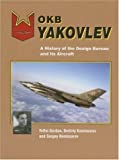
OKB Yakovlev: A History Of The Design Bureau And Its Aircraft
The Yakovlev design bureau started life in 1927 when Aleksandr Sergeyevich Yakovlev (1894-1977) brought out his first aircraft, the two-seat AIR-I. The first nine designs created by Yakovlev remained in prototype form, being developed largely at his own initiative. In 1935, however, his fortune changed when the UT-2 primary trainer entered large-scale production. In the immediate pre-war years and during World War II, the Yakovlev OKB proved quite versatile, developing such varied aircraft as the Yak-4 light bomber of 1939, the Yak-6 light transport, and the Yak-1 fighter of 1940. The latter was the progenitor of a highly successful series of fighters including the Yak-7, Yak-9, and Yak-3. After the war, diversity continued. For a while, fighters were still strongly on the agenda; the Yak-15 first flew on 24 April 1946, the same day as the MiG-9, and eveolved into the Yak-17 and Yak-23 featuring the same ‘pod-and-boom’ layout. The twin-engined Yak-25 interceptor was brought out in 1952, again becoming the first in a line of twinjet tactical aircraft - mostly bombers and reconnaissance aircraft. Civil aircraft development also continued on a large scale, the OKB developing such successful aircraft as the Yak-18 trainder/aerobatic aircraft family, the Yak-40 feederliner (1966) and the Yak-42 short/medium-haul airliner (1974). The company even tried its hand at helicopters; the tandem-rotor Yak -24 was brought out in 1952, entering small-scale production in 1955. Though overshadowed as a ‘fighter-maker by Mikoyan and Sukhoi, the Yakovlev OKB did not give up. The Yak-38 VTOL attack aircraft first flew in 1970, entering service with the Soviet Navy in 1976. A major success was achieved in 2002 when the Yak-130, the company’s latest trainer, was selected by the Russian Air Force.